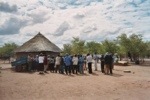
 Our drive into the mountains by over lander truck, kindly nicknamed the “Cocky Robin”, had taken us past small villages and citrus groves, women walking with babies on their backs and large vessels of water on their heads, and roadside stands selling American brand T-shirts that read Adidas and Nike. I found it strange how so many people wore American brands or shirts that said, “I love New York” or “LA Dodgers.” Our African translators even had American names – Jeffery and Stewart. Buses bursting at the seams, filled with passengers and animals passed us periodically, and I often wondered what it must be like to be one of the sea of humanity who had to travel in a such a cramped and stifling environment. Americans start complaining if their flight is delayed for even a few minutes. The roads in Zimbabwe, more often than not, were one lane dirt roads, and I would watch and wonder if we were going to die with the next approaching truck or bus. Somehow, by the grace of God, we would squeeze past each other, and I would be able to take a breath again. Our guides were “MK’s” or missionary kids, who all grew up in Zimbabwe. All three were young adults, that shared a zest for life and had so much knowledge about the area and the people.
When we arrived at our campsite, it was late in the day, and we had to rush to get the tents up. Once the sun went down, it was utter darkness. I didn’t realize until then, what true darkness was. When lying in the tent without the assistance of any light, a hand waved in front of the face was impossible to see. I guess I had always been around some type of light, and the realization of complete darkness scared me. I prayed for safety because I felt completely vulnerable. Our bathroom consisted of a long walk with a flashlight to a tiny, cement structure with a hole in the floor – not somewhere one would go without an escort, or as we called it, a lookout. When we set up the tents, all the villagers gathered and stared. They spoke in Shona, and I wondered what they were talking about. We were told to secure all money and valuables in the safe in the truck. They referred to it as the refrigerator. We women were paired up in tents, but we decided that we would rather sleep three to a tent than to leave one of us alone. We put all of our duffle bags in the other tent, and then we could change in there. We had dinner that was prepared over the fire by our guides. They slept in the truck and on top of it to protect it. Once night fell, we sat by the fire and talked with our translators about Africa and America. They were young, college-age brothers whose parents had died from AIDS. The chief/pastor of the village had a wife and two daughters who also acted as translators for us. The daughters didn’t arrive until the next morning. They attended college in the city, and they had to walk all night to get to the village. They walked in the complete darkness, without shoes, through the mountains at night -unbelievable to me but true none the less. I asked Jeffery if they worried that something would happen to the girls, but he said they did it all the time. He said children would often go missing because they were used in sacrificial ceremonies of witchcraft. At that point, I was not a believer of such practices, but I soon found out they were very real. He also told me how people in Harare and other places would be taken from their homes by the government for speaking out against officials. They were never seen again. He told me that we should never speak of the government to anyone because they had spies everywhere. I went to sleep that night wondering if spies were watching us from behind the trees. During the night, I heard a truck go through the camp. Trucks weren’t common among the villagers, really not at all. The chief was considered to be the wealthiest of the group, and he only had a bike that we gave him. The missionary who met us there had a Toyota pickup, but that was only because he was American. I wondered who our visitors were, and the next morning I was told it was a visit from local officials to see what we were up to. Many nights we would hear explosions off in the distance. There were mine fields close by from a prior war with Mozambique. Cows wandered throughout the village and would often wander into the mine fields during the night. Cows don’t read so they never had a chance. I saw many people, including children, with missing legs due to coming in contact with unseen mines.
Each morning, we would get up around sunrise, eat breakfast, and meet for prayer and instructions. I was paired with Jeffery, an older gentleman from my church named Gene, and the chief/pastor’s wife. Everyone called her “Amai” which means mother in Shona. After our morning meeting, we would walk to an area of the village to which we were assigned. We would knock on the gate of each hut and wait for a response. The person at home would come out and converse with our translator and then ask us into their courtyard, so to speak. We would sit on a tree log, stump, or strewn fabric and the homeowner would offer us water. It was rude not to accept the offer, but I was told all the water came from the bore hole, otherwise known as a well. We had been drinking the same water as it was brought to us in large barrels upon our arrival. The bore hole was dug by World Vision, and due to its depth, it was presumed safe. The water from the bore hole actually tasted much better than the water we had been drinking from the tank on the truck. The water tank on the truck was right next to the diesel tank, so it pretty much tasted like diesel fuel. After exchanging small talk, we would explain that we were there to share some information with them about Jesus Christ. We had printed “tracts”or small sheets with excerpts from the book of John. The villagers were very kind to us, and they would ask us questions as we explained Jesus’s life and ministry. We would end with the ABC’s – Accept Christ into your heart, believe that he died for your sins, and make a public confession/ profession of your belief in Him. If they didn’t decide at that that time to accept Christ, we would ask to pray for them or their family. They would often just want us to pray with them, which we were happy to do. Sometimes, they would ask us what we did to sin (because we told them we were all sinners and needed Christ). I was a little taken off guard by this, but I would try to be as honest as possible without delving too deep. Two women told us they couldn’t accept Christ because they made alcohol which they sold for money to support the family. They used berries from a local tree to do this. In the Shona culture, drinking, smoking, and cursing were looked down upon. The village had their own system of justice for immoral behavior. We offered to pray with them.
One day, the missionary dropped us off a far distance from our campsite. We were to walk around another area of the village and talk as we usually did. It was very hot, even though it wasn’t noon yet. In the mornings, the women worked in the fields while caring for the children. The men went off, and mostly only the elderly were at home. Their family unit was strong and all members were to support each other financially. If a death occurred, the dependent went to live with other family members. Elderly family members were taken care of by their adult children. Many of the elderly had cataracts due to the bright sun and the lack of sunglasses. Sometimes medical missions would come and provided eye exams and used glasses. Lines were long and many were turned away due to lack of time. While walking back to meet our missionary for pick up, we saw a man sitting in the middle of a mine field. He was old and missing a leg. We stopped and asked the man if he needed help. We couldn’t go in, but maybe he could retrace his steps to find a safe way out. He told us he had purposely gone into the field because he was cursed. He said that he wanted to die because there was nothing he could do about the curse. He looked very disoriented, and we couldn’t convince him to come out. We told him what we were talking about with the villagers and asked him if he was interested in becoming a Christian. He wasn’t interested in accepting Christ, but he did want us to pray for him. We prayed with him, and we finally coaxed him out of the mine field.


- Comment
- Reblog
-
Subscribe
Subscribed
Already have a WordPress.com account? Log in now.
 Sainte Terre