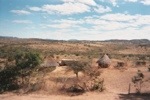
 In 2005, I decided to go to Africa. My friends and family thought I had lost my mind, but I didn’t care. I felt that God had a plan for me, one that I didn’t exactly understand, but it was something I had to do. I had never been out of the U.S., and I had never talked to strangers about my faith. I often questioned myself. What could a white, blonde-haired, blue eyed, thirty-four year old American woman do to change the world? I was told that the people we would be living among for two weeks lived in thatch-roofed huts and were considered some of the last unreached people groups left in the world. The only medical care they received was from passing mission groups, and the well they drank from had been dug by World Vision. Before the well, many died of water born illnesses. Children’s life expectancies depended on immunizations brought by traveling mission groups as well.
On July 4th, when all my family was at our lake cabin celebrating, I was on a plane to the unknown. We were headed for Johannesburg, South Africa, and then our final destination, so I thought, was Harare, Zimbabwe, formerly Rhodesia. We landed In the Cape Verde Islands at night, where we refueled, restaffed, were searched again, and then we were off again in under an hour. From Harare, we would travel by over lander truck to a village up in the mountains. I had been told that Zimbabwe was a dangerous place, and that it was under the grip of a cruel and merciless dictator, Robert Mugabe. Even though he was “elected”, he uses his power to influence voters through violent means. Those who oppose him are not given food rations and their homes are bulldozed. We witnessed the devastation from the bulldozing. We were told not to wave with an open hand at anyone, or make a fist because this could be taken as an act of disrespect to Mugabe. His primary political opponents used hand gestures to signify defiance and strength of their own political party. We were also told that he had spies everywhere, therefore we were always being watched. At the time, I didn’t believe it, but as it turned out, we were like specimens in a jar, being observed at all times to see what our movements would entail. Later, when we arrived at the Harare airport, we declared that we were on holiday – not entirely the truth. The fact was we had hidden Bibles in our luggage and planned to share our faith with the people of Africa. A pastor who was considered to be the chief of the village we were going to, wanted us to help him start a church. If we were searched and our Bibles discovered, they would have seized them and probably deported us, or worse if they felt like it. We always had money on our side. Money is the great equalizer at airports worldwide – at least third world airports. If you offer them enough money, they turn a blind eye to things. Small amounts of U.S. currency is more than they make in a month. They can feed their families on that money and are more than eager to accept it. Men dressed in military regalia stood on city streets in Harare with automatic weapons, and could and did board vehicles to check for papers at anytime. Banks were especially fortified. At the time, most people in Zimbabwe were “millionaires” because they had to carry around wads of cash just to buy a loaf of bread. Money had been printed to “help” the sinking economy, but all it really did was devalue money to the point of worthlessness. There was a gas shortage, which left long lines at the pump, and in most cases no gas for many. Smart people or people with any kind of wealth, bought gas over the border in Zambia or Mozambique. Hospitals looked more like run down shacks, and I was told someone could die in the street and it was no big deal. It was not a place to get sick. I had immunizations for various illnesses known to the area in Zimbabwe, and I also took Malarone daily to prevent Malaria. For some reason, I wasn’t scared. I guess I should’ve been, but I felt God’s leading, and I was excited to see the beautiful continent of Africa. We finally landed in Johannesburg. We were greeted by a white man with a sign who was dressed like Crocodile Dundee. He had an Australian accent and was holding up a sign for our group. The first words he spoke were, “Hello mates. Is this your first time to the continent?” I wondered if we had landed on the wrong continent. I later realized there are many Australians in South Africa. He was friendly, and he was to be our guide for the rest of our stay in Johannesburg. It was a bustling city with interstates running through it. Once outside the city, things changed. Make-shift villages sprang up along the interstate. These represented the black sections. I was told that the whites and blacks still chose to live separately. The whites drove around in Mercedes and the blacks walked everywhere. Homes in the city had walls around them to keep out unwanted visitors. Historically, the Shona people built Great Zimbabwe and are known for their great stone walls and structures. These walled cities throughout Zimbabwe have been carbon dated to 600 A.D. These past historical practices are seen in the structures of Johannesburg as well. Some say these walls were originally built to keep out wild animals.
Even though Apartheid had ended it, it really didn’t change the socio-economic situation of the common man in South Africa. Freedom doesn’t guarantee wealth. One major difference from the U.S. was the dark smoke, always visible, which was coming from fires people lit by their homes to stay warm. The smell of smoke permeated everything. We toured an animal preserve in Johannesburg, and then boarded a plane to Zimbabwe. We landed in Harare at night and had to unload on the Tarmac. We then boarded a bus for the terminal. We stayed the night at an American missionary’s compound and left the next day for the mountains. For reasons of protection, I won’t mention his name, but he left our church as a boy, and has devoted his life to the people of Zimbabwe. He’s a good man, who lives simply, and he truly has a heart for God. After arriving in the mountains, we set up camp in a clear space in the middle of a village. What was to come changed my life.
Everything I Needed to Know, I Learned in Africa
This entry was posted in Uncategorized and tagged #Africa. #missions, #culture, #faith, #politics, #religion. Bookmark the permalink.


 Sainte Terre
Reblogged this on JohnnyAngel Advocacy Group and commented:
Like to never go back,but cry racism against the country that was stupid enough to elect me twice!!
Thanks for the comment and the reblog. It’s always good to remember the past so we can shape our future!